
Electrical guide
What does a Level 2 EV charger cost to install, and can your panel handle it?
What goes into the cost of a home Level 2 EV charger in North Texas, how to tell if your panel can handle it, and when a panel upgrade is needed.
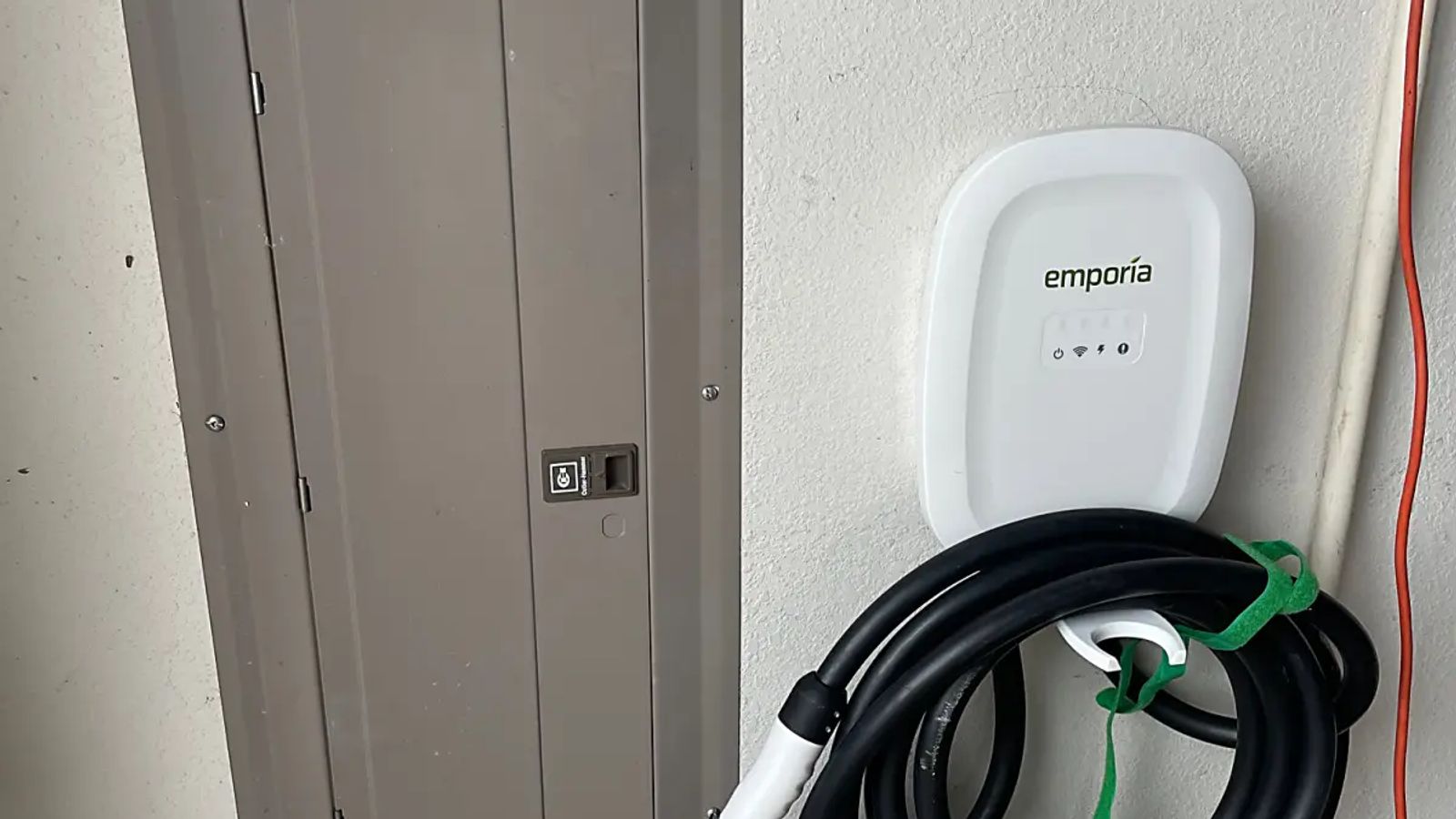
A Level 2 charger can add 20 to 30 miles or more of range per hour of charging, compared with a few miles per hour from a standard household outlet. Most EV owners in North Texas install one in the garage. Here's what affects the cost and how to tell whether your electrical panel is ready.
What you're paying for
- The charger: home Level 2 chargers commonly range from a few hundred dollars to around $800, depending on brand, features, and amperage.
- The circuit: a dedicated 240-volt circuit from your panel to the charger, sized to the charger. This is usually the largest part of the labor cost.
- The permit and inspection: most North Texas cities require a permit for a new 240-volt circuit.
- Extra work if needed: a long wire run, an outdoor location, a detached garage, or more panel capacity.
Koryente's typical installation price in North Texas, not including the charger, is $800 to $1,800 when the panel is in or next to the garage, $1,500 to $3,000 when the panel is across the house, and $2,500 to $5,000 for a detached garage or a long run. If your panel needs more capacity, a panel or service upgrade typically runs $3,500 to $6,500. Your exact price depends on your home. Try our electrical cost estimator, then ask for a written quote.
The two biggest cost drivers
1. Distance from the panel
Every foot of wire between the panel and the charger adds material and labor. A charger mounted on the garage wall right next to the panel, like the one pictured above, is the least expensive setup. A charger on the far side of the garage, outside, or in a detached building costs more.
2. Panel capacity
A Level 2 charger is a large, continuous load. Most draw 32 to 48 amps for hours at a time, on a 40- to 60-amp circuit. Your panel needs both an open space for a 2-pole breaker and enough capacity left over after your air conditioner, range, dryer, and water heater.
Can your panel handle it?
Start with your main breaker size, usually printed on the large breaker at the top of the panel:
- 200 amps: most homes with 200-amp service can add a Level 2 charger without an upgrade.
- 150 amps: often workable, depending on what else is on the panel.
- 100 amps or less: often tight once you add central AC and electric appliances. A load calculation will tell you for sure.
An electrician confirms capacity with a load calculation, which adds up what your home actually uses. You can run the numbers yourself with our free electrical load calculator.
If your panel is short on capacity
- Charge at a lower amperage: many chargers can be set to draw less, which still fully charges most cars overnight.
- Load management: a device that pauses charging when the home's demand is high, avoiding an upgrade in many cases.
- Panel or service upgrade: adds capacity for the charger and future needs like a second EV, a generator, or a remodel.
Hardwired or plug-in?
Some chargers plug into a 240-volt outlet like a dryer's, and others are hardwired. A hardwired charger can often deliver more power, avoids wear on an outlet, and is required for some higher-amperage units. Outlets for EV charging must be GFCI-protected, and they need to be heavy-duty enough for hours of continuous use.
Rebates and tax credits
Incentives change often. The federal tax credit for home EV chargers ended for chargers placed in service after June 30, 2026. Check with your electric provider and your vehicle's manufacturer for any current rebates before you buy.
Koryente installs Level 2 EV chargers and handles panel upgrades for homes across Van Alstyne, Anna, Melissa, McKinney, Sherman, and nearby North Texas towns.
Common questions
How much does it cost to install an EV charger at home?
Koryente's typical price to install a Level 2 charger is $800 to $1,800 when the panel is in or next to the garage, $1,500 to $3,000 when it's across the house, and $2,500 to $5,000 for a detached garage or a long run, not including the charger. A panel upgrade adds to that if your panel lacks capacity. A written quote for your home is the only way to know for sure.
Do I need a panel upgrade for an EV charger?
Not always. Many homes with 200-amp service have room. Homes with 100-amp service often need a load management device or an upgrade. A load calculation tells you which.
What size breaker does a Level 2 charger need?
It depends on the charger. A charger that draws 40 amps typically needs a 50-amp circuit, and a 48-amp charger needs a 60-amp circuit, because chargers are a continuous load. Follow the charger's installation instructions.
Does a Level 2 charger add value to a home?
Many buyers see a garage charger as a plus, especially in growing EV areas like Collin County. It also makes daily charging much faster and more convenient.
Can I plug my EV into a regular outlet?
Yes, with the cord that comes with most EVs, but a standard 120-volt outlet adds only a few miles of range per hour. A Level 2 charger is much faster for daily driving.
Related services
Not sure what you're seeing?
If a breaker, outlet, or light keeps acting up, a licensed electrician can find the cause safely.
Request service